Plate III.
Tabula posologica: dose schedules as recorded
The trial-protocol titration ladder, FDA-labeled maintenance doses, and the pharmacokinetic figures that anchor a weekly schedule.
The titration ladder, briefly
Tirzepatide is given as a once-weekly subcutaneous injection — a small injection under the skin, rotated between the thigh, abdomen, or upper arm. The dose starts low and climbs slowly, by design: the FDA label documents a 2.5 mg starting dose for four weeks, then a step to 5 mg, with optional increases of 2.5 mg every four weeks up to a maximum of 15 mg. That slow escalation is not incidental — it is the primary strategy for managing nausea and gastrointestinal side effects during dose adjustment. The three maintenance doses tested across the large SURPASS and SURMOUNT trials are 5 mg, 10 mg, and 15 mg once weekly. The drug stays in the body for roughly five days on average (elimination half-life), which is what makes once-weekly dosing viable. Doses are reported here as they appear in the label and trial protocols — never as a personal recommendation.
Titration as recorded in the trial protocols
The Phase 3 trials of tirzepatide — across SURPASS for type 2 diabetes and SURMOUNT for chronic weight management — used a stepwise subcutaneous titration scheme designed to manage the gastrointestinal tolerability profile of incretin therapies. Participants began at 2.5 mg once weekly for four weeks. The dose was then increased to 5 mg once weekly for the next four weeks. Subsequent increments of 2.5 mg every four weeks brought participants to their assigned maintenance dose of 5, 10, or 15 mg, with the maximum dose studied being 15 mg once weekly [17].
This schedule appears, with small variations, across the published Phase 3 program and is reproduced on the U.S. FDA label for the approved formulation [18]. The 2.5 mg starting step is not characterized as a therapeutic maintenance dose — it is a tolerability-bridging dose. The clinical maintenance doses studied in the pivotal trials and approved on the label are 5, 10, and 15 mg once weekly.
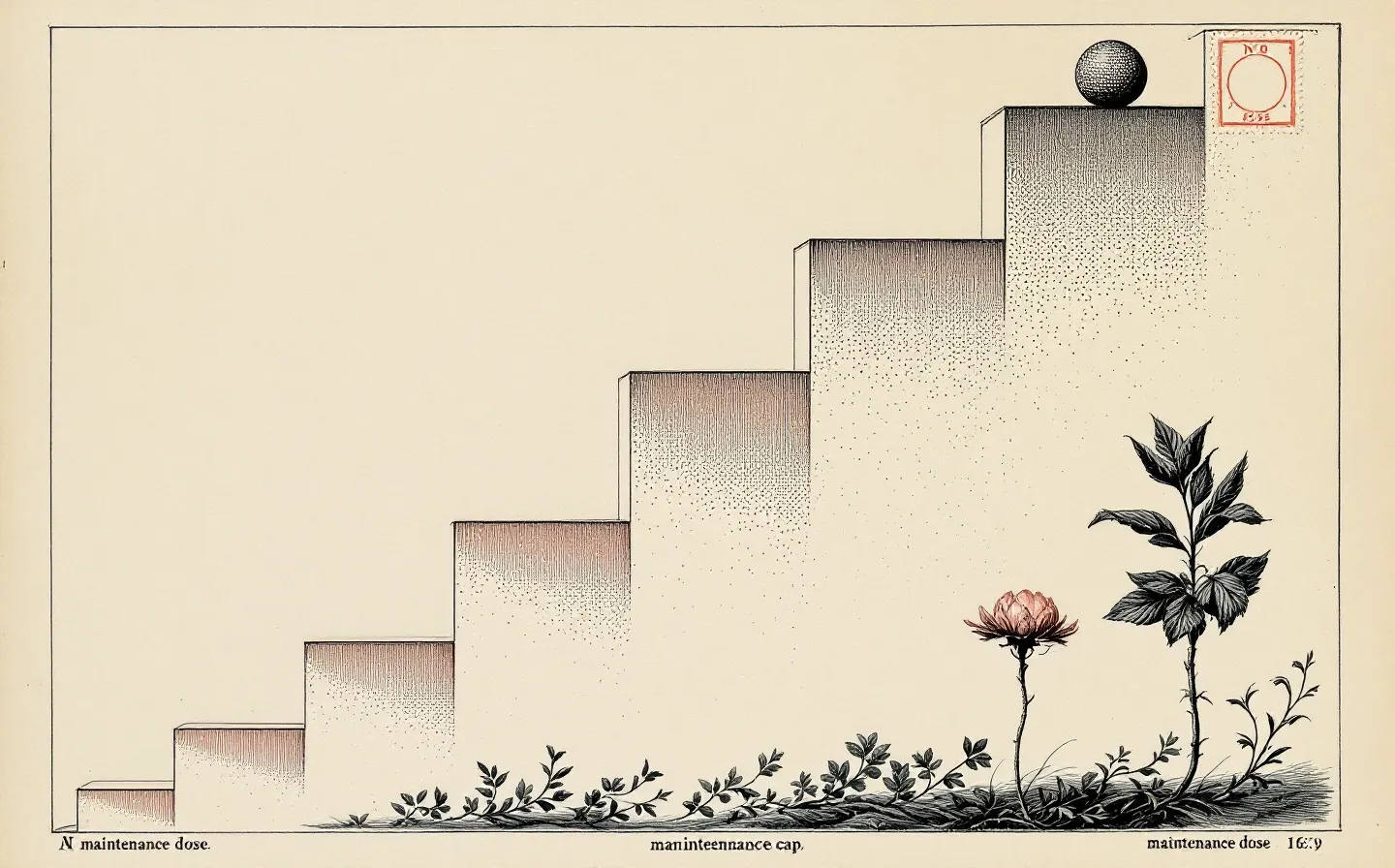
FDA-labeled maintenance doses
Under the FDA-approved labeling for tirzepatide injection, the recommended maintenance doses for both the type 2 diabetes indication and the chronic weight management indication are 5, 10, or 15 mg administered subcutaneously once weekly [18]. The decision among 5, 10, and 15 mg is a clinical one made with a prescribing clinician and is not addressed by this site.
The trial program established dose-response across the three maintenance doses on both glycemic and weight-management endpoints. In SURPASS-2, HbA1c reductions of −2.01, −2.24, and −2.30 percentage points were observed at 5, 10, and 15 mg respectively; weight reductions across the same arms were 7.6, 9.3, and 11.2 kilograms [6]. In SURMOUNT-1, weight reductions of 15.0, 19.5, and 20.9 percent were observed at 5, 10, and 15 mg over 72 weeks [8]. The gradient is real and statistically separable across the three doses on both axes.
Pharmacokinetics that anchor the weekly schedule
Tirzepatide's once-weekly subcutaneous schedule rests on a specific pharmacokinetic profile. Plasma albumin binding is approximately 99 percent, driven by the C20 fatty di-acid moiety on the backbone, with absolute bioavailability following subcutaneous administration near 80 percent [1]. Mean apparent clearance is 0.061 L/h. Steady-state plasma concentration is reached after approximately four weeks of weekly dosing — the rationale for the four-week minimum interval between titration steps. The elimination half-life is approximately five days.
In the clinical pharmacology cohorts, intravenous administration was used only to characterize the disposition kinetics; the subcutaneous route is the only route studied at therapeutic exposures and the only route approved for human use under the FDA label [18].
Route, storage, and handling as documented
Tirzepatide is administered subcutaneously once weekly. The approved formulation is supplied in a temperature-controlled state and intended for refrigerated storage according to the labeling instructions. Degradation of peptide therapeutics is accelerated by heat and light, and the FDA label specifies handling parameters for the approved formulation [18].
Material sold outside the regulated pharmaceutical supply chain as 'tirzepatide' is intended for laboratory research only and is not characterized for human use under regulatory authority. Identity, purity, sterility, and endotoxin content of such products are not verified by any regulatory body. Med Tirzepatide is a pressed editorial herbarium — it does not sell, distribute, or endorse any product. Questions about the approved formulation are appropriately addressed to a licensed prescribing clinician.
Background therapies in the trial program
Tirzepatide was studied across the SURPASS program against a range of background therapies. SURPASS-2 was conducted on background metformin against semaglutide [6]. Pooled SURPASS analyses examined outcomes across participants taking SGLT2 inhibitors and RAS inhibitors at baseline; the urinary albumin-to-creatinine ratio reductions and the broader renal signal were preserved across those subgroups [16].
SURPASS-5 evaluated tirzepatide added to titrated basal insulin in adults with type 2 diabetes; the combination produced greater HbA1c reduction with less weight gain than insulin intensification alone. Combination with metformin and SGLT2 inhibitors was common across the program and remains the most common real-world background context for the type 2 diabetes indication. Combination decisions are a matter for prescribing clinicians; this site reports the trial design only.